One of the most interesting among the treatments applied in prostate cancer is Lutetium Therapy - PSMA therapy. When prostate cancer spreads to the other regions of the body, that is, when metastases develop, hormone medicines are started in patients first. If the number of prostate cancer metastases is high, giving the hormone medicines together with chemotherapy leads to more gratifying results in patients.
Although prostate cancer patients feel very well while using hormone medicines, after a while resistance also develops to the hormone medicines. This period varies between 2 and 10 years from person to person and depending on the type of the cancer. In prostate cancer patients in whom resistance to hormone and chemotherapy treatment develops, quality of life deteriorates and serious pain emerges in the patients. Whereas in the past there was no treatment we could offer to patients in this situation apart from giving strong painkillers, recently many new drug treatments and treatment methods have appeared.
Prof. Dr. Murat BİNBAY and Assoc. Prof. Dr. Serkan KUYUMCU from the Department of Nuclear Medicine of Istanbul University Istanbul Faculty of Medicine have summarised the unknowns about lutetium therapy.
What Is Lutetium PSMA Therapy?
Lu177-PSMA therapy performed in nuclear medicine, is a treatment method carried out using smart molecules that specifically target prostate cancer cells. In this treatment a special radioactive substance is used that targets the prostate cancer cells and destroys the prostate cancer cells after being given into the body.
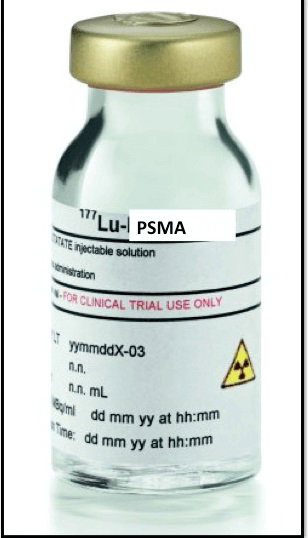
The injected smart drug 177Lu-PSMA
How Does Lutetium PSMA Act?
In prostate cancer the disease can spread to the lymph nodes close to the prostate gland, and at an advanced stage to the bones and the lungs. Lutetium-PSMA therapy shows its therapeutic property by targeting the prostate cancer cells in organs such as the lymph nodes, bone and lung where prostate cancer has spread and giving radiation "only to the cancerous cells".
Is Lutetium PSMA Given to Every Prostate Cancer Patient?
In general Lutetium-PSMA is preferred in situations where prostate cancer has spread to other organs, in the presence of disease resistant to hormone therapy and chemotherapy. However, every patient must be evaluated individually and whether they will benefit from the treatment must be addressed with a multidisciplinary approach.
Recently lutetium therapy can be applied to prostate cancer patients with intense metastases before hormone therapy and chemotherapy.
What Are the Benefits of Lutetium PSMA Therapy?
It has been shown that lutetium PSMA therapy reduces the pain in a significant proportion of patients who are at an advanced stage of prostate cancer and who have complaints of pain because of metastases.
The PSA values used in the follow-up of prostate cancer fall after the treatment. In much of the literature it has been shown that it increases survival time and quality of life in advanced-stage prostate cancer patients.
How Are Patients Evaluated Before Lutetium PSMA Therapy?
Lutetium PSMA therapy is a treatment performed in the nuclear medicine department, and patients must definitely be evaluated by a nuclear medicine physician and the treatment planning must be done by the nuclear medicine physician.
These patients are generally directed to the nuclear medicine unit by urology, medical oncology or radiation oncology specialists. However, patients who apply directly to the nuclear medicine treatment outpatient clinic of university hospitals can also be evaluated by nuclear medicine specialists.
There are some imaging and biochemical examinations that need to be performed in order to determine the suitability of the patients planned for treatment. They are generally examinations that are easy to perform and do not tire the patient.
Among the tests definitely requested from patients before treatment, examinations mostly performed in the department of nuclear medicine such as PSMA PET imaging, complete blood biochemistry, dynamic kidney function tests and GFR measurement can be counted. However, every patient is evaluated individually and the examinations to be requested may differ from patient to patient. This evaluation must be done by your nuclear medicine physician.
In a prostate cancer patient with advanced-degree metastases, the regression seen in the cancerous areas in the 3rd year after lutetium therapy has been marked with red circles.[/caption]
Does the Lutetium PSMA Therapy Test Have Side Effects?
Lutetium PSMA therapy does not have side effects that negatively affect quality of life such as nausea and hair loss seen after some chemotherapies in cancer patients.
In situations where the disease is very widespread in the bones, there may be side effects such as a fall in blood values in the medium term after treatment. However, because the follow-up of the patients is carried out regularly after treatment, these generally temporary effects can be kept under control.
In addition, while the patients are being evaluated before treatment, in patients in whom the probability of such effects appearing is high the treatment dose is adjusted according to the patient. Among the long-term side effects a decline in kidney functions in some patients can be counted. These side effects are not seen in every patient.
One of the aims of the pre-treatment evaluation is also to detect the patients in whom these side effects may be seen and to create a treatment plan specific to each patient in order to minimise the side effects.
Can Lutetium PSMA Therapy PSMA PET Test Be Applied to Patients with Kidney Failure or Undergoing Dialysis?
Lutetium PSMA therapy can be performed in patients with a creatinine level of 2 or below (<2 mg/dl).
How Many Cycles of Lutetium PSMA Therapy Are Applied?
Lutetium therapy is applied as 4 cycles at intervals of 2-4 months. The total number of cycles may be less or more than 4 in some patients. The period between cycles may also vary from patient to patient. The nuclear medicine physician who does the treatment planning must decide on the number of treatments, the treatment intervals and the treatment dose with the pre-treatment evaluation results and the post-treatment follow-up results.
How Is Lutetium PSMA Therapy Applied?
The admission procedures of patients for whom treatment planning has been made and a treatment decision has been taken are carried out on the morning of the appointment day. After the admission procedure is completed, the radioactive substance used in Lutetium-PSMA therapy is specially synthesised in the Department of Nuclear Medicine. Afterwards the prepared drug is given to the patients intravenously. This procedure is completed within the same day. In general patients are discharged the same day before the end of working hours.
What Should I Do After Lutetium PSMA Therapy Has Been Performed?
Patients discharged after treatment must have a blood test done for follow-up after the period determined by the nuclear medicine physician. This period will vary from patient to patient.
In general the first blood test is done 2-4 weeks after the treatment. The tests to be carried out are requested and followed up by the nuclear medicine physician.
Do Patients Emit Radiation to People Around Them After Lutetium PSMA Therapy?
In lutetium PSMA therapy the doses of radioactive substance given to the patient and the amounts of radiation the patients emit from their bodies are at an acceptable level. The energy of this radioactive substance is low and its half-life is approximately 6 days.
After treatment, before the patients are discharged, the amount of radiation spreading outside their bodies is measured by nuclear medicine physics engineers. Because the amount of radiation the patients emit falls below the values permitted by the Turkish Atomic Energy Authority, the patients can be discharged.
The radiation safety rules are explained in detail to the patient and the patient's relatives before the patient is discharged, and an information form is given to the patients. In general they are rules that are easy to comply with. However, as the most important rule that must be paid attention to, patients should not approach small children and pregnant women closer than a certain distance.
More detailed information on this subject can be obtained from the nuclear medicine department outpatient clinics, from the physics engineers on duty or from nuclear medicine physicians.
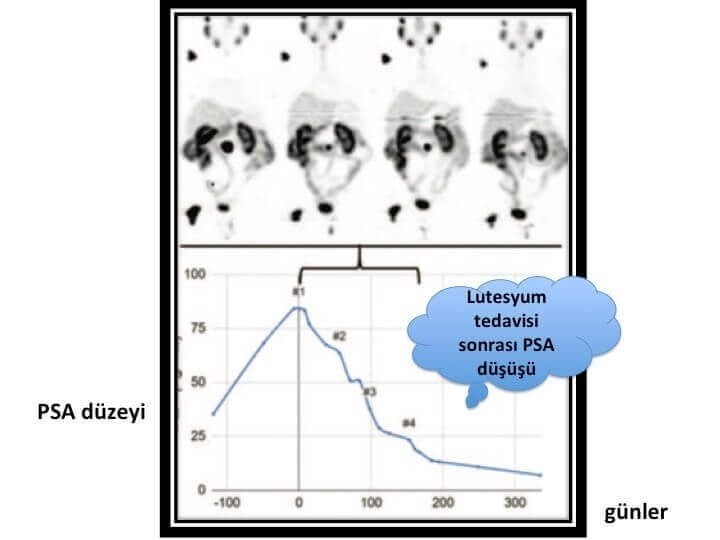
The fall seen in the PSA level after lutetium therapy in a patient with metastatic prostate cancer is shown.
According to the review published in March 2018 in the journal Current Opinion Urology about lutetium PSMA therapy, it stated that in the studies carried out Lu-PSMA therapy can be applied successfully with acceptable side effects in patients with metastatic prostate cancer.
*In this review the results of a total of 593 patients receiving Lu-PSMA therapy were examined.
NOTE: Lutetium therapy is not yet used in our country.
Clinical Note
This article was written and medically reviewed by Prof. Dr. Murat Binbay, a urologist with more than 25 years of experience and over 1,500 robotic operations. The assessments reflect current international guideline recommendations together with our own clinical practice.
The information here is for general guidance only. Because every patient's history, imaging findings and comorbidities differ, a treatment decision can only be made after an examination. You can reach us through our contact page, or read more about our physician on the about us page.
Sources
- European Association of Urology — Prostate Cancer Guidelines
- National Cancer Institute (NIH) — Prostate Cancer
- Türk Üroloji Derneği — Güncel Kılavuzlar
Last reviewed: 8 September 2026 · Reviewed by: Prof. Dr. Murat Binbay, Urology and Robotic Surgery Specialist
Let Prof. Dr. Murat Binbay's team review your case
If you read this far, you probably have questions. Fill in the two-minute digital consultation form and we will get back to you within 24 hours.
- Answer within 24 hours
- Your data stays confidential

Urology and Robotic Surgery Specialist · 25+ years of experience
Last medically reviewed:
 Önceki Yazı
What Is Prostate Surgery With Water?
Önceki Yazı
What Is Prostate Surgery With Water?
 Sonraki Yazı
Symptoms and Treatment of Retroperitoneal Fibrosis
Sonraki Yazı
Symptoms and Treatment of Retroperitoneal Fibrosis
Yorumlar
Yorum Yazın
Henüz yorum yapılmamış. İlk yorumu siz yapın!