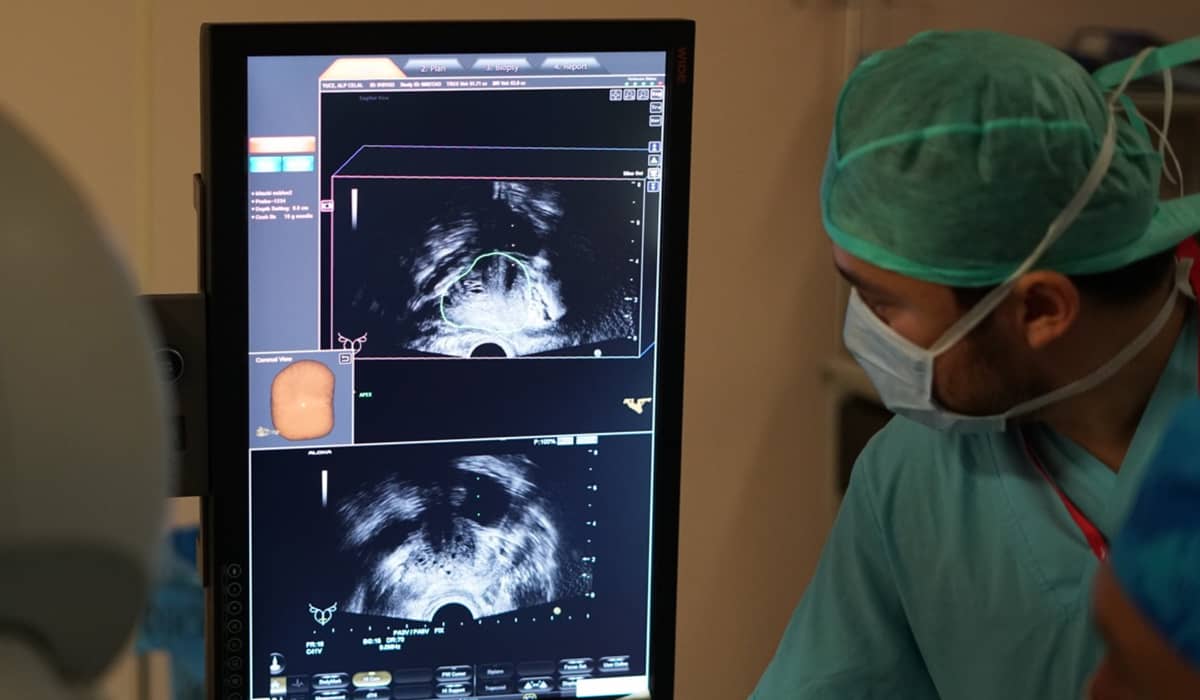
If we describe the HIFU technique simply, it is the destruction of the cancerous tissue in the prostate by heating it with sound waves. In the treatment of prostate cancer, which is quite frequently seen in men, when one says;
- a method without surgery,
- a non-invasive robotic method,
- a local method focusing only on the tumour,
- a method with fewer side effects
the treatment procedure called HIFU frequently comes to mind among the treatment options.
Cancer Treatment Without Surgery: The HIFU Technique
High Intensity Focused Ultrasound, or HIFU, is an FDA-approved, minimally invasive procedure for the treatment of prostate cancer that offers personalised treatment and significantly reduced side effects.
HIFU uses non-ionising ultrasonic waves to heat tissue without any need for an incision. HIFU can be used to increase blood or lymph flow or to destroy tissues such as tumours.
The technology is similar to ultrasonic imaging, but lower-frequency and continuous waves are used instead of pulsed waves in order to achieve the necessary thermal doses.
One of the most frequently seen types of cancer in the world is prostate cancer. >> https://cdn.rohanmedya.com/murat-binbay-cdn/prostat-kanseri
Its History
HIFU was first used in the 1940s and 1950s to destroy tumours in the central nervous system.
Since then, studies have been carried out to show that HIFU is effective in destroying malignant tissue in the brain, prostate, spleen, liver, kidney, breast and bone.
HIFU was approved in the United States in 2015 for prostate tissue ablation. HIFU is also used for the ablation of prostate cancer.
The Working Logic of the HIFU Technique
With the High Intensity Focused Ultrasound (HIFU) technique, the aim is to treat only the cancerous area instead of removing the whole prostate.
What is aimed at in this technique is the approach of not removing the secretory glands around the prostate, not closing the channels coming from the testicle, and not affecting the patient's sexual life and urinary continence.
Its Shortcomings and Disadvantages
Prostate cancers generally occur in more than one area. The aggressiveness of the cancer in each area is not the same. In prostate biopsies there can be areas missed in making the diagnosis. For this reason, cancer recurrences can be seen with HIFU performed only on certain areas within the prostate.
With today's MRIs we can identify the cancerous areas within the prostate at a rate of 50%. Particularly in the less aggressive cancers that are the target of HIFU treatment, the probability of MRI being inadequate is even greater.
In HIFU treatments performed on areas close to nerves or muscles, erection disorder or urinary incontinence can occur.
If a cancer recurrence occurs in a patient who has had HIFU, the prostate cancer surgery to be performed afterwards can be very challenging for surgeons (because of adhesions). This situation leaves the patient facing a high risk of complications.
The Mechanism of the Treatment
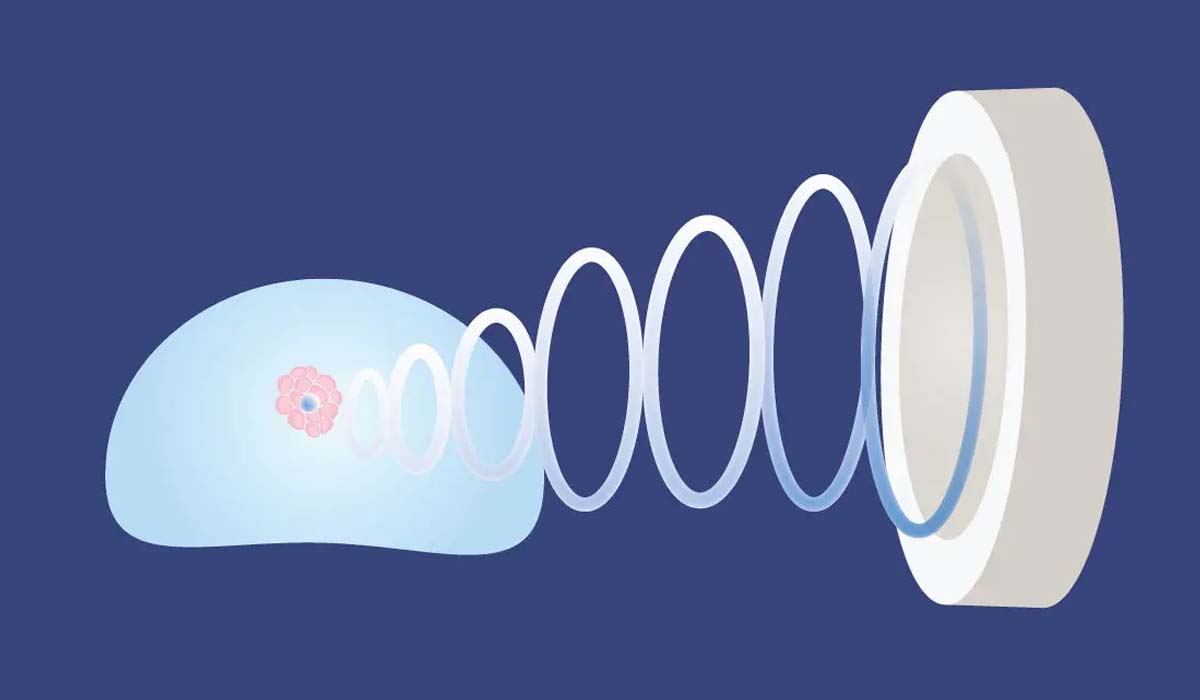
The mechanism by which HIFU targets, burns and destroys diseased prostate tissue is similar to the sun's light rays passing through a magnifying glass and making a clear hole at an intersection point right in the middle of a leaf opposite it.
HIFU uses sound waves instead of light as its energy source. Instead of a magnifying glass, a transducer is used. The focusing effect of the transducer allows high sound pressures to be delivered to a focal point without causing unwanted damage to other tissues.
The temperature of the tissue at the focus will rise to 65 to 85 °C and will destroy the diseased tissue by coagulation necrosis.
HIFU beams are precisely focused on a small area of diseased tissues and store a high level of energy locally in that area. In the ultrasound used for diagnosis, on the other hand, because the sound waves are not focused on a point, this heat is not of a degree to be of concern.
In the HIFU method, each sonication (individual accumulation of ultrasound energy) treats a precisely defined part of the targeted tissue by burning it. For this it intervenes on tissue sections of 0.2 mm with very precise calculation.
The sound waves directed at the prostate tissue rapidly raise the tissue temperature and destroy only the cancerous lesions and do not damage the healthy surrounding tissue.
Application and Method
The ultrasound energy or sound waves are delivered to the prostate by means of a spoon-shaped applicator placed through the anal region (rectum).
The sound waves are focused on the desired points within the prostate, identified with MRI (magnetic resonance imaging) and confirmed with ultrasound.
The intrarectal position of the applicator is followed three-dimensionally and in real time. This real-time imaging is necessary for safe and accurate non-invasive targeting and treatment monitoring.
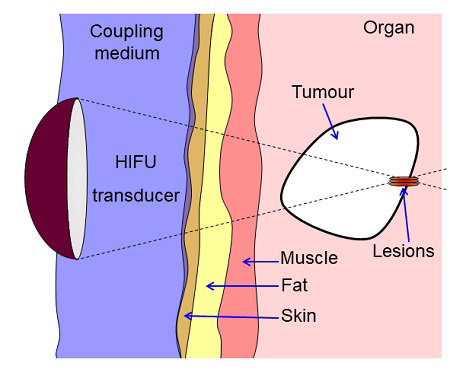
A diagram showing how HIFU can be used to destroy tissue in the body. An acoustic lens is used to focus the sound on a small point in the body. The sound passes through many layers of tissue. Because of the focal gain, only the tissue at the focus is destroyed.
The Advantages of the HIFU Technique
- The cancer tissue can be treated without damaging the surrounding organs.
- With the possibility of outpatient treatment, the treatment is completed the same day.
- When necessary, it can be applied again at a later time.
- It is non-invasive. There is no surgery or blood loss.
- It contains no radiation, the patient is not exposed to radiation.
- It is a personalised, targeted treatment.
- It has a lower side effect profile compared with other treatment methods.
- In recurrences after HIFU there is still the chance of surgery or radiotherapy.
Which Patients Can HIFU Be Applied To?
HIFU can be applied to patients with a tumour limited to the prostate or limited to the peri-prostatic area.
It can be used in the treatment of localised tumours mostly classified as T1 and T2.
It can be preferred for patients whose clinical condition is not suitable for radical prostate surgery.
In cancers that recur after radiotherapy, HIFU is an important alternative treatment as "salvage treatment".
To obtain information about robotic radical prostate surgery >> https://cdn.rohanmedya.com/murat-binbay-cdn/robotik-cerrahi-prostat-kanseri-ameliyati
A Sample Prostate Cancer Case Suitable for HIFU Treatment
- Cancer visible on MRI
- No cancer detected in any other area within the prostate in the biopsy performed
- The cancer is limited to within the prostate
- The degree of aggressiveness of the cancer is low
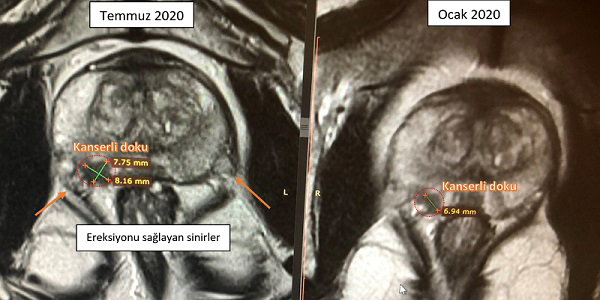
This case was caught in January 2020. The patient did not accept treatment at first. On the MRI taken 6 months later it was detected that the cancerous area had grown. In the second prostate biopsy performed it was seen that there was no cancerous tissue in any other area within the prostate. This cancer in the prostate is a cancer far from the nerves, limited to within the prostate and not aggressive. A suitable patient for HIFU.
Things to Be Done Regarding the Procedure
On the morning of your HIFU treatment, an enema is given for you to empty your bowels.
A catheter is fitted at the start of the treatment to drain the urine from the bladder.
Sedation/anaesthesia is applied to the patient at a level sufficient for them not to feel pain.
You will generally have your catheter for 3-7 days after the treatment. (To drain your urine from your bladder until the inflammation after the procedure subsides)
If you are planning to have children, you may wish to resort to sperm storage methods before HIFU for use in fertility treatment.
Side Effect Profile
In general the side effects of HIFU are fewer than the side effects of other treatments.
- Urinary problems (burning on urination, urinary incontinence)
- Difficulty in achieving and maintaining an erection.
- Minimal bleeding may be seen in the urine while the catheter is in place.
- Small pieces of prostate tissue may be seen in your urine for 6-8 weeks after HIFU.
- Very rarely, infection in the urinary tract, inability to urinate.
- The situation of semen going into the bladder during ejaculation
- Rarely, the formation of a passage (fistula) between the anal canal and the urinary channel after HIFU treatment (faeces coming with the urine)
Follow-Up After Treatment
Your PSA level is expected to reach its lowest level a few months after HIFU.
After HIFU treatment, PSA checks are carried out at 3-6 monthly intervals.
Situations in Which HIFU Treatment Is Not Recommended
A very large prostate volume (in some cases closed prostate surgery (TURP) is performed first and the part of the prostate around the urinary tract is cleared)
The anus being very narrow (to a degree that could prevent the HIFU probe from entering the rectum)
The presence of a large amount of prostate stones within the prostate (this can lead to HIFU scattering and transmission disorder)
Conclusion
Among the very varied treatment alternatives for prostate cancer, focal treatments such as HIFU are the non-invasive answer to the question "Could more treatment than necessary be being given?". On this subject it is in competition with the local radical treatment (prostatectomy) and watchful waiting approaches that appear in the treatment guidelines.
HIFU is a current treatment method, still under investigation, applied as local treatment in primary prostate cancer, as salvage treatment after the failure of radiotherapy and surgery, and as accompanying supportive treatment in locally advanced prostate cancer.
Clinical Note
This article was written and medically reviewed by Prof. Dr. Murat Binbay, a urologist with more than 25 years of experience and over 1,500 robotic operations. The assessments reflect current international guideline recommendations together with our own clinical practice.
The information here is for general guidance only. Because every patient's history, imaging findings and comorbidities differ, a treatment decision can only be made after an examination. You can reach us through our contact page, or read more about our physician on the about us page.
Sources
- European Association of Urology — Prostate Cancer Guidelines
- National Cancer Institute (NIH) — Prostate Cancer
- Türk Üroloji Derneği — Güncel Kılavuzlar
Last reviewed: 8 September 2026 · Reviewed by: Prof. Dr. Murat Binbay, Urology and Robotic Surgery Specialist
Let Prof. Dr. Murat Binbay's team review your case
If you read this far, you probably have questions. Fill in the two-minute digital consultation form and we will get back to you within 24 hours.
- Answer within 24 hours
- Your data stays confidential

Urology and Robotic Surgery Specialist · 25+ years of experience
Last medically reviewed:
 Önceki Yazı
What Is Cystoscopy and How Is It Applied?
Önceki Yazı
What Is Cystoscopy and How Is It Applied?
 Sonraki Yazı
What Is PSMA PET in Prostate Cancer?
Sonraki Yazı
What Is PSMA PET in Prostate Cancer?
Yorumlar
Yorum Yazın
Henüz yorum yapılmamış. İlk yorumu siz yapın!