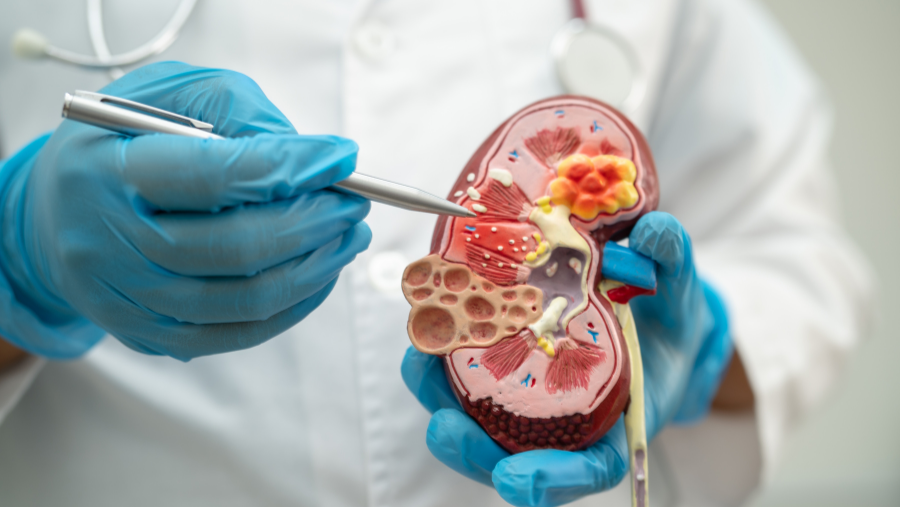
Kidney stones are solid masses formed when minerals and salts in the urinary tract harden and crystallise. They can be as small as a grain of sand or large enough to fill the entire kidney.
Although some stones progress silently for a long time without causing symptoms, they most often lead to severe pain and complaints that impair quality of life. Particularly when symptoms such as blood in the urine, pain in the back and flank or burning on urination are noticed, it is necessary to consult a urologist without delay. Early diagnosis is of vital importance both for bringing the pain under control and for preserving kidney function.
Kidney stone formation has many causes and can affect any part of the urinary tract from the kidneys to the bladder. It generally arises when minerals crystallise and stick to one another as a result of the urine becoming concentrated.
The types of stone forming in the kidney can vary:
- 80% - calcium oxalate stones
- 10% - struvite stones (magnesium ammonium phosphate)
- 5-10% - uric acid stones
- 1% - cystine (methionine) stones
Note: The type of stone affects the treatment method and the risk of recurrence.
Why Do Kidney Stones Form?
We do not know exactly what causes kidney stones to form, but certain lifestyle and health factors can increase your likelihood of developing them. For example:
- Inadequate fluid intake
- Excessive protein intake
- Too much vitamin D supplementation
- Inadequate or excessive calcium intake
- Obesity
- Hormonal and metabolic disorders
- Gout and bowel diseases
- Family history (the risk increases 2.5-fold if a parent is affected and 4-fold if a sibling is affected)
What Are the Symptoms of Kidney Stones?
Kidney stones can sometimes remain silent without causing any symptoms. However, when a stone passes from the kidney into the urinary channel it causes severe pain and complaints that restrict daily life. While 1 in every 10 patients experiences no pain at all, in most people the symptoms are quite striking.
If the stone enters the channel or causes swelling in the kidney, you may experience the following signs and symptoms:
- Severe pain that starts suddenly below the ribs, in the flank or the back and comes in waves
- Pain radiating towards the groin and lower abdomen
- A sensation of burning and pain on urination
- Blood in the urine (the urine turning pink, red or brown)
- A constant urge to urinate
- Nausea, vomiting
- Foul-smelling urine
- Fever and chills (particularly if a urinary tract infection is present)
- Blood in the urine (haematuria)
Important: When any of these symptoms is encountered it is necessary to consult a urologist without delay. Because if left untreated, stones can damage kidney function and the risk of infection can become life-threatening.
How Are Kidney Stones Diagnosed?
The diagnosis of kidney stones is made by imaging methods performed after the patient's complaints and physical examination.
In the diagnostic process, imaging methods: ultrasound, plain abdominal X-ray, CT; laboratory tests: urine and blood tests; and physical examination and complaints are assessed together.
Passing a Kidney Stone and How Long It Takes
Stones forming inside the kidney later pass in time into the ureter. The ureter is the channel that connects the kidney to the bladder and allows urine to flow.
Small stones (<5 mm) can mostly pass on their own. Medical intervention is required for larger stones.
Stones under 4 mm: 80% pass on their own
Stones of 4-6 mm: 60% pass naturally
Stones over 6 mm: mostly require treatment
Stones in the part of the ureter close to the bladder have a higher likelihood of passing.
Is There a Way to Pass Stones Faster?
Uric acid stones are stones that can be dissolved. Unfortunately they make up only 10-15% of all kidney stone patients. If your doctor thinks you have a uric acid stone, the stone may be dissolved with drug treatment.
If your stone is of a size that can pass, that is, smaller than 5 mm, an attempt can be made to pass it. Drinking plenty of water (at least 3 litres a day), sitting in a warm bath, painkillers and prostate medicines are the methods recommended for passing a stone. Apart from these, herbal treatments (Guelder rose juice; Rovatinex) can also help in passing a stone.
The process of trying to pass a stone located in the kidney must be carried out under the supervision of a urologist. Trying to pass a large stone can cause you to lose your kidney.
While trying to pass a stone, a rise in temperature and even a serious kidney infection can occur because of the obstruction in your urinary tract. In that case you must go to hospital immediately and be assessed by a urologist.
Trying to pass a stone in the kidney can be very painful. Taking painkillers does not speed up the passage of the stone, but it eases the pain that occurs as the stone moves and can make you more comfortable. A heating pad or hot water bottle can also help in passing a stone. On the other hand, pain is an important warning mechanism of the body. If your pain has gone while passing a stone, either you have passed the stone or your kidney may have stopped working. To be sure you have passed the stone, always have a check-up with your doctor.
The diameter and elasticity of the urinary channels can differ from person to person. Some stone patients can also pass stones of 7-8 mm, but only 5% of people are that fortunate. For this reason we DO NOT RECOMMEND that you try to pass stones larger than 5 mm naturally!
Kidney Stone Treatment Methods
The aim in the treatment of kidney stones is to relieve the pain, prevent damage to the kidney and ensure that the stone is expelled safely from the body. When choosing the appropriate kidney stone treatment for the patient, the decision is made according to the type of stone in the kidney. Urine tests and imaging tests may be performed to decide on one of the treatment options.
The most important thing patients need to pay attention to in the treatment of kidney stones is consuming an adequate amount of fluid. Drinking 6-8 glasses of water a day increases urine flow and makes it easier for stones to be expelled naturally. The treatment methods applied in the treatment of kidney stones include the following:
1- Drug Treatment
Painkillers and narcotic medicines can be used in the treatment of stones forming in the kidneys. Antibiotics are used to treat infection in the patient. In drug treatment, medicines are recommended after examination by a doctor according to the cause and type of the stone.
Allopurinol is used in the treatment of uric acid stones, thiazide diuretics in calcium stones, and phosphorus solutions in calcium stones.
2- Lithotripsy
In the extracorporeal shock wave lithotripsy (ESWL) method, high-frequency shock wave energy is used to break up stones. These waves are directed at the stone through the skin so that the stone is broken into small pieces.
3- Tunnel Surgery (Percutaneous Nephrolithotomy)
The doctor makes a small incision in the patient's back to reach the kidney stones and, entering from there, breaks up the stones in the kidney. This method is preferred if the stone is causing obstruction or infection and damaging the kidneys. Percutaneous nephrolithotomy is also preferred if it is not possible for the stone to be expelled naturally.
At the very beginning of the treatment process the doctor may immediately recommend percutaneous nephrolithotomy and request removal of the stone. This means that it is not possible for the stone in the kidney to be passed by other means. The size of the stone is more than 6 mm.
4- Ureteroscopy
A stone passing from the kidney may become lodged in the patient's ureter or bladder. An instrument called a ureteroscope is used to remove this lodged stone.
A ureteroscope is a wire with a camera fitted at its tip. This wire is advanced from the patient's ureter to the bladder. The lodged stone is captured, grasped and removed.
Today the open surgical method is almost never used. In all cases, before starting treatment a urine culture must be taken and the absence of infection confirmed.
In the treatment of kidney stones, lithotripsy with sound waves (ESWL) should be attempted at most 3 times. ESWL is not an innocuous and harmless treatment.
Ways to Protect Against Kidney Stones
Although it is not possible to eliminate the risk of kidney stones entirely, you can significantly reduce the likelihood of recurrence with lifestyle changes. Drinking plenty of fluids, eating a balanced diet and having regular medical check-ups are of critical importance at this point.
- Drinking 2.5-3 litres of water a day
- Avoiding excess salt and protein
- Tackling obesity
- Having regular medical check-ups
- Avoiding unnecessary vitamin/mineral supplements
Frequently Asked Questions (FAQ)
Do Kidney Stones Recur?
Yes, kidney stone disease can recur. Stone formation recurs within 5 years in approximately 50% of stone patients. Inadequate fluid intake, poor diet, genetic predisposition and metabolic disorders in particular increase the risk of recurrence. This risk can be reduced with regular medical check-ups and lifestyle changes.
Who Is at Risk of Kidney Stones?
Those who drink little water, those with a family history of stones, those who consume excess salt and protein, those with a problem of obesity, and those with gout and bowel diseases are in the risk group. In addition, the likelihood of stone formation is higher in those who have frequent urinary tract infections and those with metabolic disorders.
How Common Are Kidney Stones?
Kidney stones are quite common in Türkiye. Approximately 12-13 out of every 100 people are affected by this disease. While it is more common in men, the rate in women has also increased in recent years and has reached an equal level between the sexes. It occurs more frequently particularly in hot climates and in the summer months.
Does a kidney stone pass on its own?
It depends on the size of the stone. 80% of stones smaller than 4 mm can pass on their own. While 60% of stones between 4 and 6 mm pass without treatment, stones larger than 6 mm generally require medical intervention. A stone being in the part of the ureter close to the bladder increases the likelihood of it passing.
How long does kidney stone surgery take?
It varies according to the method. While ureteroscopy generally takes 30-60 minutes, percutaneous nephrolithotomy (PNL) can take 1-2 hours. ESWL (lithotripsy) is a procedure performed on an outpatient basis and may require several sessions.
Are there foods that are good for kidney stones?
Drinking plenty of water is the most important protective method. Apart from this, drinks containing citrate such as lemonade can reduce stone formation. Excessive consumption of salt and protein should be avoided. Foods high in oxalate (spinach, chocolate, tea) can trigger calcium oxalate stones. A balanced diet should be preferred.
Let Prof. Dr. Murat Binbay's team review your case
If you read this far, you probably have questions. Fill in the two-minute digital consultation form and we will get back to you within 24 hours.
- Answer within 24 hours
- Your data stays confidential

Bu konuda uzman görüş almak ister misiniz?
Prof. Dr. Murat Binbay ile randevu alarak detaylı bilgi edinebilirsiniz.
Randevu Al