Urodynamic testing is a group of examinations that use pressure and flow measurements to show how the bladder stores urine and how it empties it through the urethra; it is done to find the real cause of urinary leakage, a weak stream, frequent urination or incomplete emptying. The test is usually performed in an outpatient clinic, without anaesthesia, and takes about an hour. Only a few steps need preparation, and the most important ones are keeping a bladder diary for a few days, telling the team about your medicines in advance and arriving with a full bladder.
The same symptom can come from different mechanisms. A weak stream, for example, may be caused by the prostate narrowing the bladder outlet or by a bladder muscle that cannot contract strongly enough. An examination and ultrasound cannot always tell these apart. Because urodynamics measures the pressure inside the bladder directly while it fills and empties, it puts treatment decisions, and particularly decisions about surgery, on firmer ground.
When is urodynamic testing recommended?
Urodynamics is not needed for every urinary complaint. In most patients, the history, an examination, a urine test and an ultrasound are enough to start treatment. The test is mainly requested when first-line treatments have not worked, when the diagnosis remains unclear, or when surgery is being planned and the result could change the decision. The US National Institute of Diabetes and Digestive and Kidney Diseases (NIDDK) lists the complaints for which testing may be recommended (NIDDK, urodynamic testing):
- Leaking urine
- Going to the toilet often and feeling a sudden, strong urge
- Trouble starting to urinate or emptying the bladder completely
- Pain while urinating
- Repeated urinary tract infections
In practice, it is used most often in neurogenic bladder caused by spinal cord injury, multiple sclerosis or diabetes, in women and men with urinary incontinence who are being considered for surgery, and in prostate enlargement that has not responded to treatment as expected. The broader picture of conditions in which bladder function is disturbed is covered in our article on bladder dysfunction.
The parts of a urodynamic test
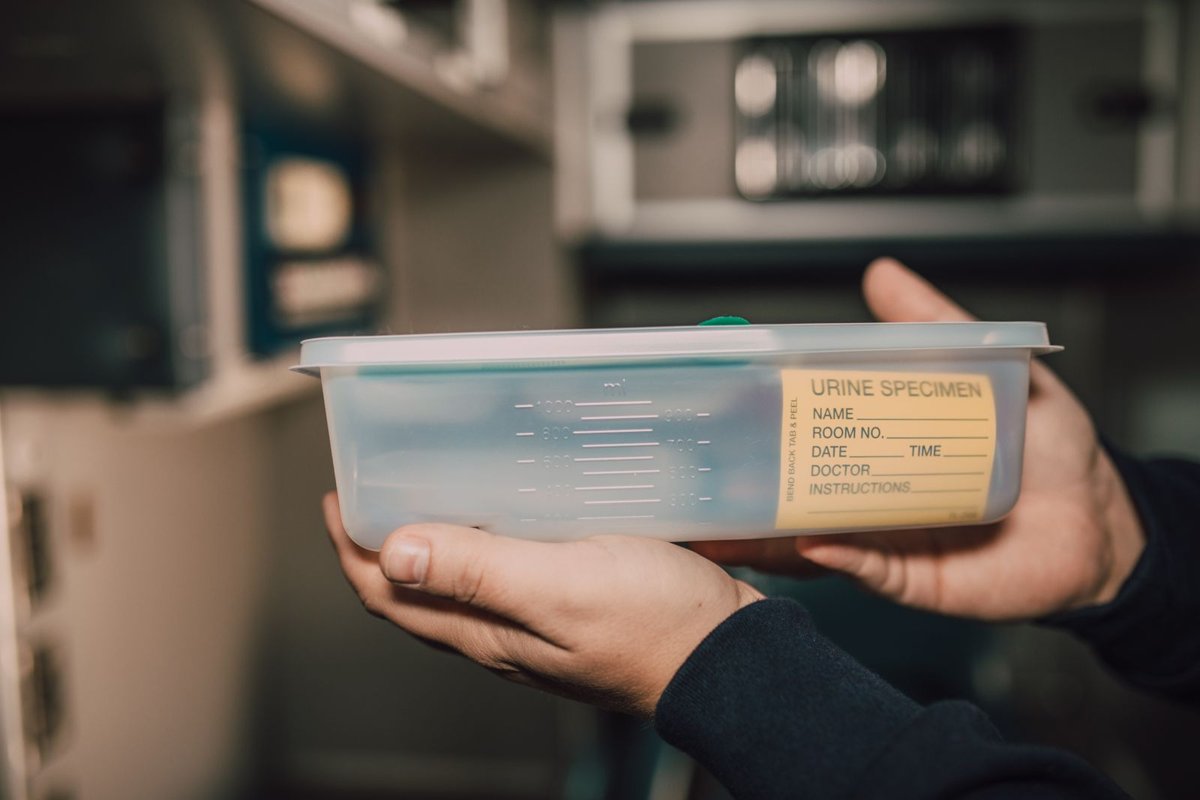
Urodynamics is not a single measurement but a combination of several tests chosen according to the complaint. Not every patient has all of them; the doctor plans the tests according to the question that needs answering.
Uroflowmetry (urine flow rate)
This is the simplest part of urodynamics. The patient urinates normally into a special toilet or funnel connected to a measuring device. The device draws a graph showing how many millilitres of urine flow per second and how long it takes to reach the highest flow rate. A low, prolonged flow may point to a blockage at the outlet or to a weak bladder muscle. For an accurate result, the bladder needs to be reasonably full.
Post-void residual urine
The amount of urine left in the bladder immediately after urinating is measured with ultrasound or a thin catheter. According to NIDDK, having 100 to 150 millilitres or more left in the bladder after urinating shows that the bladder is not emptying completely. This measurement is important in assessing chronic urinary retention and the infection risk that comes with it.
Cystometry (filling test)
A thin catheter is passed through the urethra into the bladder, and another thin catheter is placed in the rectum to measure pressure inside the abdomen. While the bladder is slowly filled with sterile fluid, the patient is asked to report the first sensation of filling, the first desire to urinate and a strong urge. Meanwhile, the bladder's capacity, how its pressure rises and whether it contracts involuntarily are recorded. The patient may also be asked to cough or strain to check whether leakage occurs with effort.
Pressure flow study
Once the bladder is full, the patient urinates with the catheters still in place. Bladder pressure and flow rate are measured at the same time. A weak flow despite high pressure suggests a blockage at the outlet, while low pressure and low flow suggest a weak bladder muscle. The clearest answer to the question asked before prostate surgery, "will this operation help this patient?", comes from this part of the test.
Electromyography and video urodynamics
In electromyography, small sensors placed near the anus show whether the pelvic floor muscles work in coordination with the bladder during urination. In video urodynamics, the bladder is filled with contrast and filling and emptying are imaged with X-ray or ultrasound, which shows whether urine flows back towards the kidneys and how the bladder neck is shaped. These two tests are used mainly in people with neurological conditions and in complex cases.
How should you prepare for the test?
NIDDK notes that most urodynamic tests need no special preparation. Even so, a few simple steps make the test more comfortable and the results more reliable. In our clinic, we ask patients to:
- Keep a bladder diary for two or three days before the test, noting how much you drink, how often and how much you urinate, and any episodes of urgency or leakage. The NHS also recommends a diary of at least three days when assessing incontinence (NHS, diagnosing urinary incontinence).
- Bring a list of all the medicines you take. You may be asked to stop some of them, such as overactive bladder or prostate medicines, a few days before the test; your doctor will decide which ones, so do not stop anything on your own.
- Arrive with a comfortably full bladder so that the flow rate can be measured first.
- Let the team know in advance if you have signs of infection such as burning, fever or cloudy urine; the test is usually postponed during an active infection.
- Wear comfortable clothes that are easy to take off.
What happens during and after the test?
The test is carried out by a urologist and an experienced nurse in a room where privacy is respected. The catheters are inserted with an anaesthetic gel and are roughly as thin as the tip of a pen; most patients describe mild discomfort, but pain is not expected. It is important to say what you feel throughout the test, because the values recorded during cystometry are interpreted together with what you report. Some people find it hard to urinate in front of others; this is very common, the team is used to it, and the measurement can be repeated if needed.
For a few hours after the test you may feel mild burning and need to urinate often. NIDDK suggests that drinking a glass of water every half hour for two hours may ease the discomfort. A slightly pink colour in the urine can also be temporary. Fever, shivering or increasing pain, however, may be signs of infection, and you should contact your doctor straight away. Because a catheter is used, there is a small risk of urinary tract infection, and the doctor may recommend a preventive antibiotic for patients at higher risk.
How do the results guide treatment?
Simple measurements such as flow rate and residual urine are often assessed as soon as the test ends; more complex recordings such as electromyography and video urodynamics may take a few days to interpret. The results do not make a diagnosis on their own; they are read together with your symptoms and other tests. A few examples show how the test affects decisions.
In a man with an enlarged prostate, if the pressure flow study shows a genuine outlet blockage, he is likely to benefit from surgery. If the bladder muscle is weak, it becomes uncertain how much an operation will improve the flow, and this is discussed openly with the patient. If a woman who leaks with effort is also found to have involuntary bladder contractions, medication and pelvic floor exercises are added to the plan before or after surgery. In neurogenic bladder, a dangerous rise in pressure during filling shows that treatment needs to be managed more closely to protect the kidneys.
If you have already been treated for urinary symptoms without getting the result you hoped for, or if you are at the point of deciding on surgery, you can ask your doctor whether urodynamics is needed in your case. You can reach Prof. Dr. Murat Binbay's team through the digital consultation page.
Frequently Asked Questions
Is urodynamic testing painful?
Usually not. You may feel mild discomfort while the catheters are inserted, but because an anaesthetic gel is used and the catheters are very thin, most patients complete the test comfortably. Mild burning for a few hours afterwards is expected.
Do I need anaesthesia or a hospital stay for urodynamics?
No. The test is done while you are awake, because reporting your sensations during filling is part of the result. You can return to your normal routine, including driving, on the same day.
Can women have urodynamics during their period?
It is possible, but it is usually done after the period has ended. This is mainly for comfort and so that the urine sample can be assessed properly. If your appointment falls during your period, you can call the clinic and change the date.
Is cystoscopy the same as urodynamics?
No, they are different tests. Cystoscopy uses a thin camera to look inside the bladder for structural problems such as tumours, stones or narrowing. Urodynamics measures function rather than producing images; it records bladder pressure, capacity and emptying strength. You can read more in our article on cystoscopy.
Will the test need to be repeated?
For most patients, one test is enough. It may be repeated if the recordings do not match the symptoms, if the patient could not urinate during the test, or if the change after treatment needs to be measured. In patients with neurogenic bladder, repeat urodynamics at set intervals is part of follow-up.
Clinical note: This article was prepared and medically reviewed by Prof. Dr. Murat Binbay, who has more than 25 years of experience in urology and has performed over 1,500 robotic operations. The information here is for general guidance only; treatment decisions can only be made after an examination. You can reach us through our contact page.
References
- National Institute of Diabetes and Digestive and Kidney Diseases (NIDDK). Urodynamic Testing.
- NHS. Urinary incontinence: Diagnosis.
- Rosier PFWM et al. International Continence Society Good Urodynamic Practices and Terms 2016. Neurourol Urodyn 2017;36:1243-1260.
- European Association of Urology. Guidelines on Non-neurogenic Female LUTS and Neuro-Urology, 2024 edition.
Last reviewed: 19 November 2026 · Reviewed by: Prof. Dr. Murat Binbay, Urology and Robotic Surgery Specialist
Let Prof. Dr. Murat Binbay's team review your case
If you read this far, you probably have questions. Fill in the two-minute pre-consultation form and we will get back to you within 24 hours.
- Answer within 24 hours
- Your data stays confidential

Urology and Robotic Surgery Specialist · 25+ years of experience
Last medically reviewed:
Yorumlar
Yorum Yazın
Henüz yorum yapılmamış. İlk yorumu siz yapın!