Robotic partial nephrectomy is the kidney cancer operation most frequently performed with robotic surgery.
Partial nephrectomy means cutting out and removing part of the kidney. Performing partial nephrectomy on a kidney with kidney cancer means preserving the healthy parts of the cancerous kidney and removing only the tumour-bearing parts of the kidney. In kidney cancers under seven cm in size, cutting out only the cancerous areas while preserving the cancerous kidney does not cause the tumour to jump to other places.
How Is Robotic Partial Nephrectomy Surgery Performed?
In partial nephrectomy surgery, while the cancerous part of the kidney is removed, the vessel bringing blood to the kidney (the renal artery) is temporarily closed so that there is no bleeding and so that the cancerous tissues can be nicely cleared. In this way the cancer clearance is carried out cleanly in a bloodless environment; after the cancerous areas have been cleared, the opened vessel openings and urinary channels are seen well and sutured. The kidney is an organ very rich in vessels and containing urinary channels. If the opened vessels and urinary channels are not sutured well after a piece has been removed from the kidney, complaints of bleeding and urine leaking into the abdomen emerge in the patient after the operation.
On the other hand, the vessel bringing blood to the kidney (the renal artery) cannot remain closed for a long time. If the closed vessels are not opened within 25-30 minutes, healthy kidney cells begin to die. For this reason the cancerous tissues must be cleared within at most 30 minutes after the vessels are closed; the open vessels and urinary channels must be sutured. In order to achieve this aim, the surgeon performing the operation must have high experience in these operations; otherwise there can be unnecessary loss of the kidney in the patient.
Oncological Results
While the cancerous tissues are being cleared from the kidney, it is important that no cancerous cell remains behind. Because I perform partial nephrectomy with robotic surgery by leaving the kidney bloodless, I am sure whether the cancerous tissues have been completely removed.
Complications
After partial nephrectomy operations, bleeding requiring intervention in the patient can occur at a rate of 3%. So far I have operated on more than 1,000 kidney cancer patients. In more than 500 of these patients I have applied partial removal of the kidney (partial nephrectomy) with laparoscopy or robotic surgery. I have not experienced loss of a kidney because of bleeding during or after the operation.
Another problem that can be experienced after kidney cancer surgery with robotic surgery is urine leakage from the kidney. After a piece has been removed from the kidney, urine can leak outside the kidney from the urinary channels that remain open. With robot surgery we also encounter this type of complication very rarely. When we encounter such a situation, fitting a stent into the kidney with the urine leak from inside and outside causes the area with the urine leak to remain dry and the wound to heal.
- Operation duration: 30-120 minutes (varies according to the size and location of the tumour-bearing tissue)
- Blood loss: 100-200 cc
- Pain: minimal
- Duration with a catheter: 1 day
- Length of hospital stay: 2 days
- Need for intensive care: none (if there is no problem relating to the patient's other diseases)
Kidney cancer surgery with robot surgery is considerably superior to other methods (open surgery, laparoscopy) in kidney-preserving operations. Despite its high costs it has many benefits for the patient.
The appearance of the wound sites on the 2nd day after kidney surgery (partial nephrectomy) with robotic surgery
You can watch the technique of our robotic partial nephrectomy surgery as an animation.
You can also watch the news video about a difficult robotic partial nephrectomy operation we performed.
How Is Robot-Assisted Surgery Carried Out?
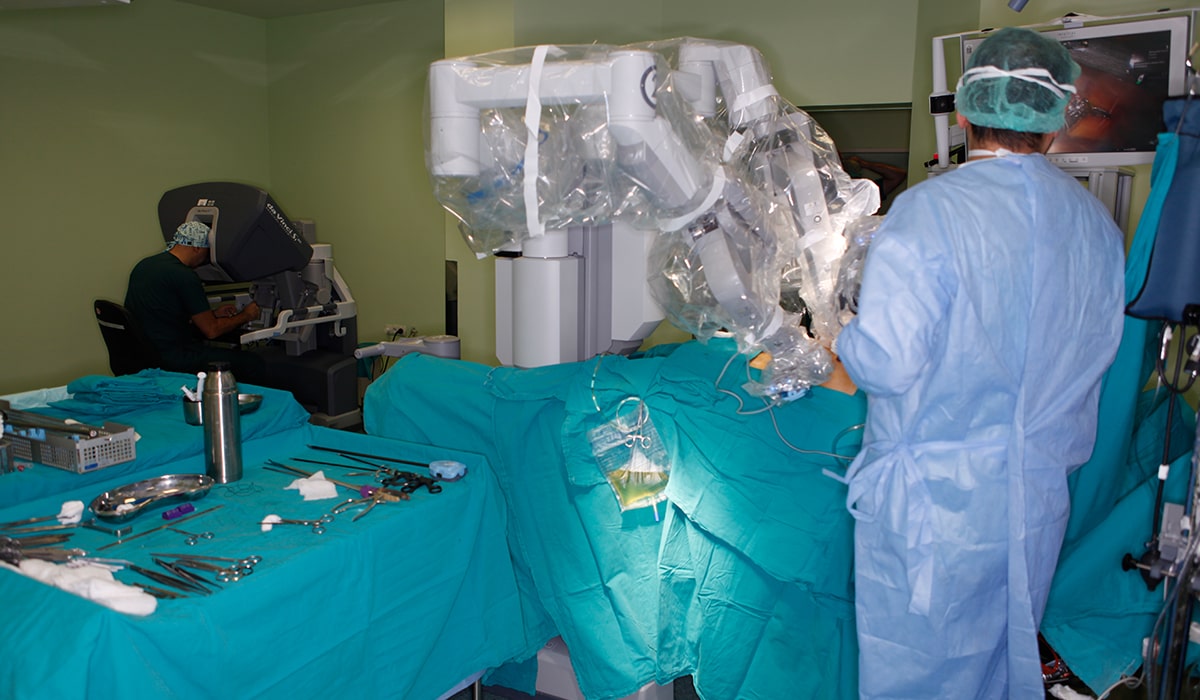
The robotic system does not perform the operation by itself. The robotic system is connected to small tubes (trocars) placed in the patient. Afterwards the surgeon who will perform the operation sits at the device called the console located in the same room as the patient. The surgeon commands the robot using the arms located on the console. The robotic system moves in line with the ability and experience of the surgeon operating it.
Think of two people playing a football match with a PlayStation. The people move the footballers in the game by means of the console. They pass, they shoot. The better the person playing the game uses the game console, the greater their probability of beating their opponent. In robotic surgery too we control the robotic system by means of a device in the same way. The robotic system does whatever we want. A system that can perform an operation by itself has not yet been developed.
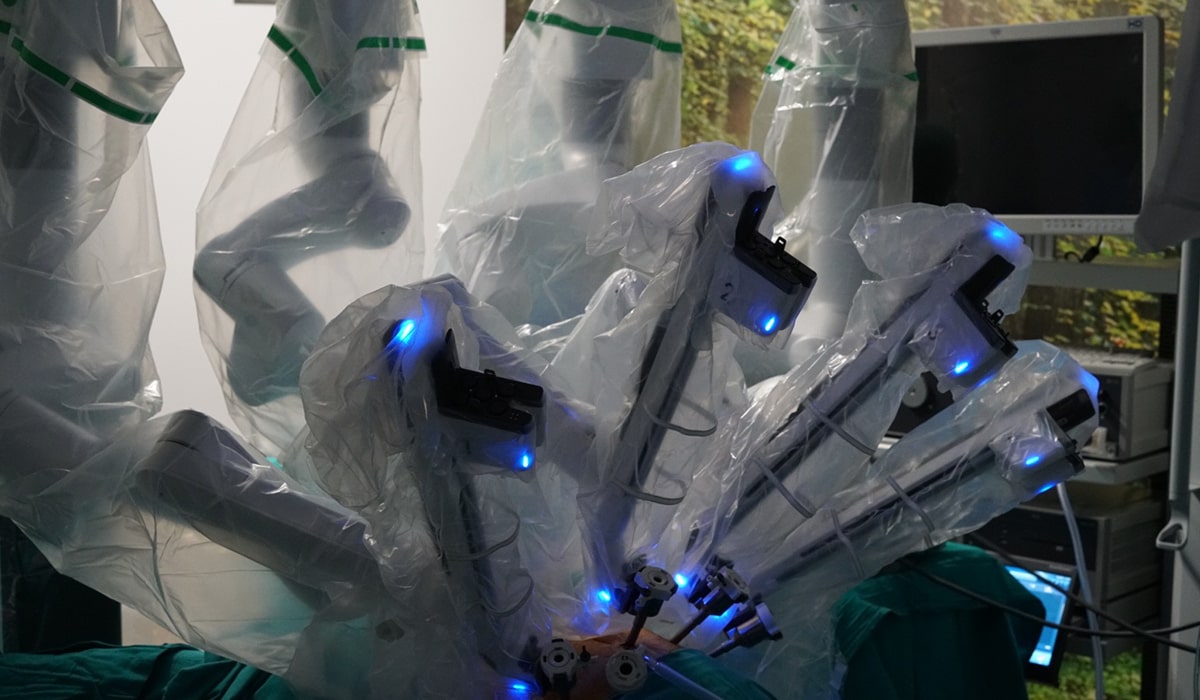
Tubes called trocars are first placed in the patient's abdomen. The arms of the robotic system are connected to the trocars. This procedure is called "docking".
The robotic instruments to be used in the operation are placed on the arms of the robot. The surgeon performing the operation sits at the console located in the same room and performs the operation. So that there is no mishap, the systems are connected to one another with cables (not Bluetooth or the internet).
We perform the operation using the arms on the console and looking inside the patient with a three-dimensional camera through the eyepieces on the console.
Radical Nephrectomy and IVC Thrombectomy
In some kidney cancers the cancer cells enter the renal veins and from there advance into the main vein called the vena cava. Kidney cancer cells can travel through the main vessels as far as the heart. In this situation, if there are no cancer cells that have jumped to another part of the body (that is, metastasised), it is necessary to remove the cancerous kidney and the tumour clot within the main vessels by surgery.
The name of the operation performed is radical nephrectomy and inferior vena cava (IVC) thrombectomy. Until the last 4 years these operations could only be performed with open surgery. In this operation, after the kidney is removed, the main vein called the vena cava is opened and the cancerous cells within the vessel are collected.
To be able to perform this operation one needs to be a very experienced and skilled surgeon. This is an operation that must be performed with zero error. Generally, in open surgery operations there is serious bleeding from the vessel while the main vein is cut and the cancer clots are cleared. After these operations 5% of patients lose their lives due to operative complications.
Bleeding After Radical Nephrectomy and IVC Thrombectomy Surgery
One of the finest advantages of performing this operation with robotic surgery is that it is possible to perform an operation with a high probability of bleeding with minimal bleeding under gas pressure. Injuries that may occur in the vessels can be easily controlled with robotic surgery.
Because the amount of bleeding is minimal, there is no deterioration in patients' general condition. While when this operation is performed with open surgery patients are generally opened up along the midline from top to bottom, in robotic surgery this operation is performed by means of a few small holes.
In radical nephrectomy surgery there is no infection at the wound sites, and the patient is discharged from hospital after 3-4 days. Patients whose kidney has been removed cannot use certain painkiller-group medicines after the operation; for this reason patients feeling little pain after the operation with robotic surgery is very important for the patient's comfort after the operation.
- Operation duration: 200-240 minutes
- Blood loss: 300-500 cc
- Pain: minimal
- Duration with a catheter: 1 day
- Length of hospital stay: 3-4 days
- Need for intensive care: 1 day (the day of the operation)
Alongside all these advantages, robotic nephrectomy and IVC thrombectomy surgery is an operation that can be performed by no more than a handful of robotic surgeons worldwide and that requires very high robotic surgical experience and surgical skill.
For the treatment of complications that may arise during this operation it is necessary to work together with a very experienced anaesthesia team. In addition, the presence of an experienced cardiovascular surgery team in the setting will be extremely useful in situations where the vessels need to be replaced in cancers that have advanced into the main vessels.
You can watch the robotic vena cava thrombectomy operation performed for the first time in Türkiye by Prof. Dr. Murat BİNBAY on an 84-year-old patient whose kidney cancer had advanced through the main vessels as far as inside the liver.
Renal Fossa Recurrence in Kidney Cancer
In large kidney cancers the whole kidney is cleared together with the fatty tissues around it. In the event of cancer cells that cannot be discerned with the eye remaining in the area where the cancer was removed, kidney cancer rarely recurs at the point where the kidney was removed. This situation is named "renal fossa recurrence" of kidney cancer.
Clearing recurrent cancerous tissues is far more difficult than the first operation in which the kidney was removed. Kidney cancer renal fossa recurrences generally arise from around the main vessels, and in addition the tissues are quite adherent to one another because of the operation undergone. For these reasons the operations of renal fossa recurrent cancers are quite open to complications.
Robotic surgery gives us an advantage in nicely separating adherent tissues. It enters the area where the main vessels are safely; in the event of any injury it allows us to treat the injury in the main vessels without bleeding. The patient gets up within a very short time after such a major operation. Their pain after the operation is minimal.
- Operation duration: 120-180 minutes
- Blood loss: 100-200 cc
- Pain: minimal
- Duration with a catheter: 1 day
- Length of hospital stay: 3 days
- Need for intensive care: none (if the patient has no problem due to other diseases)
Radical Nephroureterectomy
If kidney cancer develops not from the parenchyma (the fleshy part) of the kidney but from the urinary channels, it is necessary to remove the whole of the cancerous kidney and the urinary channels of that kidney as far as the point where they enter the bladder. This operation is called "nephroureterectomy". This operation is performed for urothelial cancers of the kidneys.
The main benefit of the option of kidney cancer surgery with robotic surgery is not in removing the kidney. It provides us with benefit in nicely removing the part of the ureter (urinary channel) that enters the bladder and the part inside the bladder.
All the operations in which only the kidney is removed as a whole because of cancer can in fact be performed with laparoscopic surgery. Of course on condition that a very experienced person in laparoscopic surgery does this job...
If the clearance of the lymph nodes is also to be involved, or if the place where the urinary channels enter the bladder is to be removed, robotic surgery gives us an advantage.
With robotic surgery this operation can be applied far more safely and without bleeding. Because the place where the ureter enters the bladder is seen and sutured very nicely, the possibility of urine leaking from that area into the abdomen is minimal. The patient's catheter can be removed earlier.
Because of the high costs of robotic surgery, laparoscopic nephroureterectomy is generally preferred instead of robotic. Because the superiority of robotic surgery over laparoscopy specifically in this type of operation is minimal, in order to lower costs I also offer my patients the laparoscopy option specifically for this operation.
- Operation duration: 90-150 minutes
- Blood loss: 50 cc
- Pain: minimal
- Duration with a catheter: 4 days
- Length of hospital stay: 2 days
- Need for intensive care: none (if the patient has no problem due to other diseases)
Removal of the Ureteral Stump
If kidney cancer develops not from the parenchyma (the fleshy part) of the kidney but from the urinary channels, it is necessary to remove the whole of the cancerous kidney and the urinary channels of that kidney as far as the point where they enter the bladder. In some situations the place where the cancerous tissue that has formed in the kidney arose may not be completely clear, or the presence of additional cancer may emerge as a result of the pathology. In such a situation, while the urinary channels (ureter) need to be removed as far as the place where they enter the bladder, they are not removed in the first operation.
As a result of the pathology, rarely the remaining urinary channel needs to be removed. Doing this is most of the time not very easy, because the patient has undergone an operation and the tissues are adherent to one another. Because the urinary channels are thin structures, finding one inside the abdomen can also be difficult.
Because kidney cancer surgery with robotic surgery provides the surgeon with a wide field of view, because with its camera showing a three-dimensional magnification feature it makes it easier for us to separate the adherent tissues, and because it allows us to comfortably suture the place where the urinary channel enters the bladder, it also provides the surgeon with a very great advantage in this operation.
Because the piece removed is a piece of tissue approximately 10 cm long and 1 cm wide, there is no need for extra enlargement of the robotic hole sites. The bloodless, painless features of robotic surgery are also valid for this operation.
- Operation duration: 90-150 minutes
- Blood loss: 100 cc
- Pain: minimal
- Duration with a catheter: 4 days
- Length of hospital stay: 2 days
- Need for intensive care: none (if the patient has no problem due to other diseases)
Clinical Note
This article was written and medically reviewed by Prof. Dr. Murat Binbay, a urologist with more than 25 years of experience and over 1,500 robotic operations. The assessments reflect current international guideline recommendations together with our own clinical practice.
The information here is for general guidance only. Because every patient's history, imaging findings and comorbidities differ, a treatment decision can only be made after an examination. You can reach us through our contact page, or read more about our physician on the about us page.
Sources
- European Association of Urology — Renal Cell Carcinoma Guidelines
- National Cancer Institute (NIH) — Kidney (Renal Cell) Cancer
Last reviewed: 8 September 2026 · Reviewed by: Prof. Dr. Murat Binbay, Urology and Robotic Surgery Specialist
Let Prof. Dr. Murat Binbay's team review your case
If you read this far, you probably have questions. Fill in the two-minute digital consultation form and we will get back to you within 24 hours.
- Answer within 24 hours
- Your data stays confidential

Urology and Robotic Surgery Specialist · 25+ years of experience
Last medically reviewed:

Yorumlar
Yorum Yazın
Henüz yorum yapılmamış. İlk yorumu siz yapın!