Prostate health takes on great importance for men as age advances. Particularly in men over the age of 50, problems such as difficulty urinating, frequent urination or not being able to empty the bladder completely because of benign prostatic hyperplasia (BPH) are frequently seen. It is at this point that TUR-P surgery (transurethral resection of the prostate), an effective surgical method, comes into play.
TUR-P surgery, successfully applied by Prof. Dr. Murat Binbay, offers patients a comfortable recovery process within a short time thanks to its being a minimally invasive method.
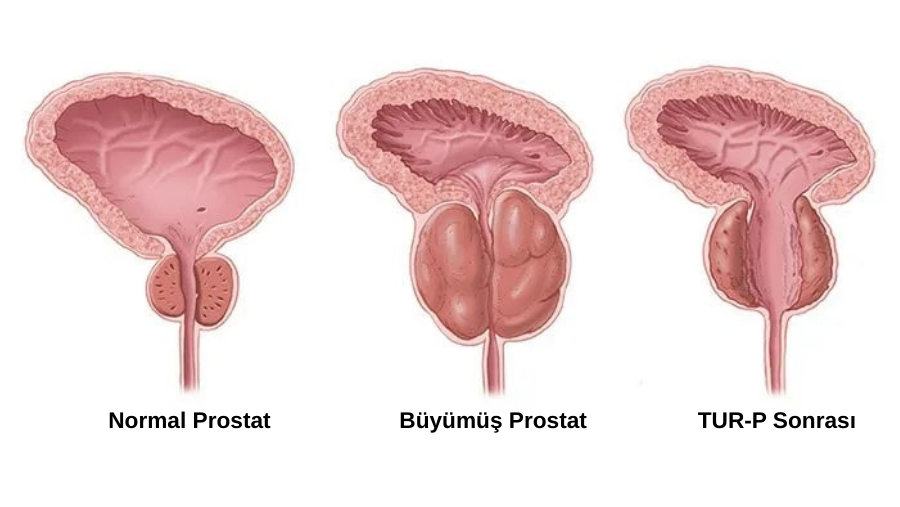
TUR-P surgery is the procedure of removing the enlarged prostate tissue by entering through the urinary tract in situations where the prostate has enlarged and is compressing the urinary channel. This procedure, performed without the need for open surgery, both eliminates urinary complaints and seriously increases quality of life.
What Is Prostate Enlargement (BPH)?
The prostate is a small gland located in the male reproductive system that surrounds the beginning of the urinary tract. With age, enlargement can be seen in this gland. Benign prostatic hyperplasia (BPH) is a condition not related to cancer, but its symptoms can be quite troublesome. The main symptoms are as follows:
- Frequent urination (particularly at night)
- Difficulty urinating
- Weakening of the urine flow
- A feeling of not emptying completely after urination
- A sudden need to urinate urgently
Although drug treatments are preferred in the first stage in the treatment of BPH, when an adequate response cannot be obtained in some patients or when serious urinary tract obstructions occur, surgical intervention is needed. At this point one of the most effective methods is TUR-P surgery.
How Is TUR-P Surgery Performed?
TUR-P surgery is a modern surgical intervention applied by the closed method with the aim of relieving the obstruction occurring in the urinary tract due to benign prostatic hyperplasia. During the operation the patient is given spinal (numbing from the waist down) or general anaesthesia. The procedure is carried out by entering through the urinary tract (urethra); the name of the special surgical instrument used for this procedure is the resectoscope.
The resectoscope both provides the surgeon with a field of view and, with the aid of electrical energy, cuts and removes in a controlled way the enlarged inner part of the prostate that is narrowing the urinary channel. During this procedure no incision is made in the patient's abdominal region. The cut prostate tissues are taken out through the urinary channel and, after the operation has been completed, a temporary catheter is fitted to the patient for control of urine output.
TUR-P surgery, which is Prof. Dr. Murat Binbay's area of expertise, generally lasts between 60 and 90 minutes. The recovery process after the operation is quite rapid and most patients can return to their daily life within a few days.
The Advantages of TUR-P Surgery
TUR-P surgery offers many advantages both in terms of patient comfort and clinical success. One of its most important advantages is that it is carried out entirely by the closed method; in this way no incision is made in the abdominal region and the recovery time is greatly shortened. Providing a marked improvement in urine flow rapidly increases patients' quality of life.
After the procedure, patients are generally discharged within 2 to 3 days. Complaints such as difficulties experienced when urinating and frequent urination decrease rapidly. In addition, the risk of long-term urinary tract obstruction after TUR-P surgery is quite low. The bleeding rate, when performed by experienced surgeons such as Prof. Dr. Murat Binbay, is reduced to minimum levels.
These advantages make TUR-P surgery a safe and effective solution for men experiencing urination problems because of benign prostatic hyperplasia.
After TUR-P Surgery
After the operation, patients are generally expected to stay in hospital for 1 to 2 days. Although the recovery process varies from person to person, some patients must avoid heavy physical activities for up to 6 weeks. During this period, temporary symptoms such as mild burning when urinating or frequent urination may be experienced. In addition, some patients may have to use a urinary catheter in the postoperative period.
The process after prostate surgery generally proceeds comfortably.
- Patients remain with a urinary catheter for a few days.
- In the first weeks, mild burning when urinating and frequent urination may be seen.
- Within 4-6 weeks these complaints largely decrease.
- It is recommended to avoid heavy exercise and sexual intercourse for approximately 4 weeks.
Who Is TUR-P Surgery Recommended For?
TUR-P surgery is an effective surgical solution generally recommended for patients in whom an adequate response cannot be obtained with drug treatments or who experience symptoms that seriously affect their quality of life. In particular, urination problems developing due to benign prostatic hyperplasia can over time lead to more serious health problems. For this reason certain clinical situations can make TUR-P surgery unavoidable.
Firstly, patients whose complaints cannot be brought under control with drug treatment are suitable candidates for this operation. In patients in whom no improvement in urine flow can be achieved despite long-term medical treatment or in whom symptoms such as frequent urination continue, surgical intervention should be considered.
In addition, people experiencing recurrent urinary tract infections should also be assessed for TUR-P surgery. The prostate enlarging and obstructing urine flow can cause urine to accumulate in the bladder, and this in turn can cause a predisposition to infections.
Urinary retention, that is the situation in which urine accumulates in the bladder and cannot be completely emptied, is one of the most obvious indications for TUR-P surgery. This situation can be both painful and cause the bladder muscles to weaken over time. In the same way, if there is a possibility of the prostate obstructing the bladder outlet and affecting kidney functions - that is, if urine is flowing back to the kidneys - this too creates the necessity for TUR-P.
It must not be forgotten that every patient is unique and the same treatment approach cannot be applied to everyone. Before deciding on TUR-P surgery, the patient's general state of health, the severity of the symptoms, age, existing treatment history and other medical findings must be assessed in detail by a urology specialist.
In conclusion, TUR-P surgery, which effectively eliminates complaints due to benign prostatic hyperplasia, is carried out safely and successfully with the expertise of Prof. Dr. Murat Binbay. With early diagnosis and correct treatment, it is possible to regain prostate health. Problems experienced when urinating must not be ignored and a urology specialist must be consulted.
Clinical Note
This article was written and medically reviewed by Prof. Dr. Murat Binbay, a urologist with more than 25 years of experience and over 1,500 robotic operations. The assessments reflect current international guideline recommendations together with our own clinical practice.
The information here is for general guidance only. Because every patient's history, imaging findings and comorbidities differ, a treatment decision can only be made after an examination. You can reach us through our contact page, or read more about our physician on the about us page.
Sources
- European Association of Urology — Non-neurogenic Male LUTS Guidelines
- NIDDK (NIH) — Prostate Enlargement: Benign Prostatic Hyperplasia
Last reviewed: 8 September 2026 · Reviewed by: Prof. Dr. Murat Binbay, Urology and Robotic Surgery Specialist
Let Prof. Dr. Murat Binbay's team review your case
If you read this far, you probably have questions. Fill in the two-minute digital consultation form and we will get back to you within 24 hours.
- Answer within 24 hours
- Your data stays confidential

Urology and Robotic Surgery Specialist · 25+ years of experience
Last medically reviewed:
 Önceki Yazı
What Is the PSA Test?
Önceki Yazı
What Is the PSA Test?
 Sonraki Yazı
Is It Possible to Detect Prostate Cancer With a Saliva Test?
Sonraki Yazı
Is It Possible to Detect Prostate Cancer With a Saliva Test?
Yorumlar
Yorum Yazın
Henüz yorum yapılmamış. İlk yorumu siz yapın!